Rat Health Care & Information (Static Archive)
|
|
Rat Health Care & Information (Static Archive) |
| Home |
Agility & Obedience |
|
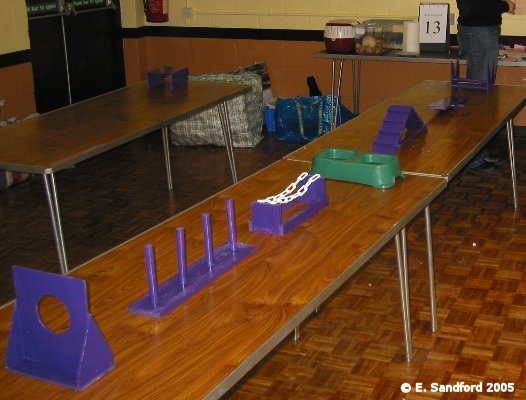
In the last few years the running of rat agility and other fun events has become more and more common at our rat shows. This shows a completely new kind of skill rat owners can do with their rats and with our rats being very intelligent little beasts; they can sometimes be very easy to train to do agility and obedience tests. A few of us have worked on some ideas for scoring agility and obedience type events and to create the guidelines we took onboard how the Swedish Rat Society run their agility events and modified their guidelines to suit ourselves. Below are our draft ideas with guidelines as to the kinds of points that should be awarded. We recently ran a 4 event agility and obedience competition at the Taunton show and it seemed to go down very well with the exhibitors. We created the guidelines for this show and below the agility guidelines are the other suggested events and guidelines. From the experience of running these events, the main things identified were a need to ensure the judge(s) understand what they are looking for in the guidelines, so this may identify a need to have trained agility/obedience judges in the future. I think all the exhibitors went away positive, thinking they need to spend more time with their rats training them for this type of event! Agility ObstaclesAll of the below were made with my own fair hands and I am by no means a DIY expert - usually far more of a 'get someone else to do it' instead! I used MDF and doweling rods and long planks of wood from a DIY superstore. I used nails for most, although wood glue was sturdy enough (I lacked patience and didn't want to wait for glue to dry!), ensured I filed and sanded down all edges and ends so there can be no injury to rat or handler and I found some wonderful purple paint to make the fences really stand out! Quinn, Sierra and Zephyrus kindly modelled the obstacles for me - the nice thing about bucks, you can put them in one place and they will stay there for photos, but it is rare for a buck to make a good agility rat! The show jump
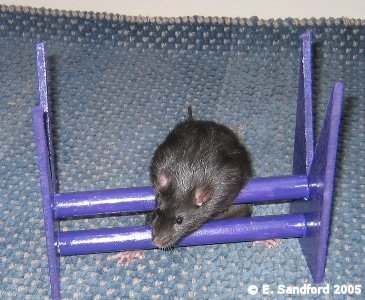
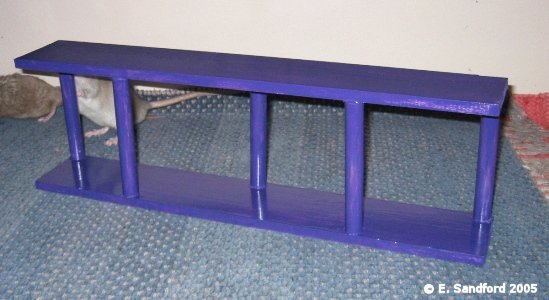
Very simple fence to create - I actually used the cut outs I had left over from another fence for the end pieces which made them a bit more original, but basically take two equal sized pieces of MDF for the ends and two equal length bits of doweling for the bars and nail or glue them together. It works best to ensure that the gaps between the bars and the table are not big enough for rats to squeeze through or under. This makes an ideal starting fence for the course as it is really simple.
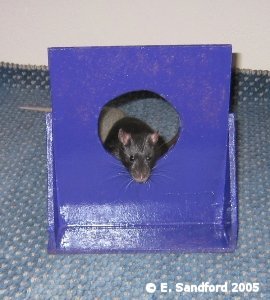
The fence with the hole in it! I used a tuna can as the template for the hole and used a small handsaw that has a pointed end for making holes in wood and followed my line on a square of MDF. I filed any sharp edges down and tested it with my largest buck to ensure most rats would get through ok. I then cut two ends and a base from the MDF and tacked them together as well as gluing them to make it easier to hold them together. This one makes an ideal finishing fence as something nice and simple to end the course.
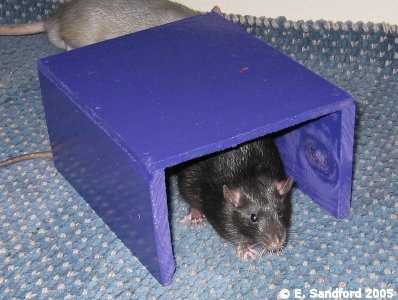
The Tunnel Another fairly simple obstacle. I cut down two lengths of wood and nailed another square of MDF to make the bridge. This obstacle has actually proved to have quite a few uses aside from being a tunnel. It can be used as a table for the staying competition and turning it over, it can be used as a starting block for the coming when called competition.
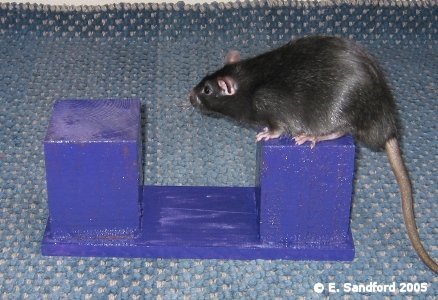
The Long Jump Very simple fence to make - take one length of wood and two lumps of wood and nail them securely together. The gap is 6 inches in this case. I used bits of fence post for my blocks. Obstacle can also be turned over to make a bridge to cross or go under.
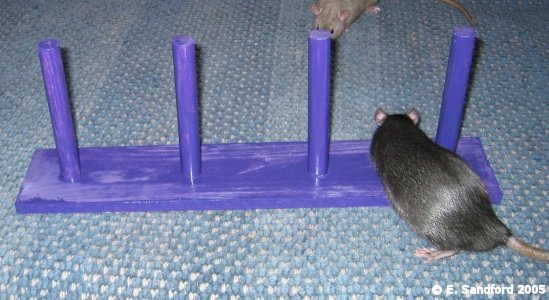
Weaving poles I cut the doweling rods into 6 inch lengths and nailed them 5 inches apart to create a weave.
Another version of the Weaving Poles
I also created a more complex version of this which could be used in several angles - it was a bit of a prototype and in hindsight I would change the offset of the poles. This can be used either flat as an under/over or as weaving poles.
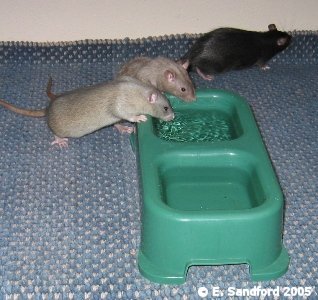
The Water Fence This double dog bowl makes a great obstacle, although my rats seem to be more interested in drinking the water than climbing over it. The usual way we use this obstacle is to get them to cross the centre ridge.
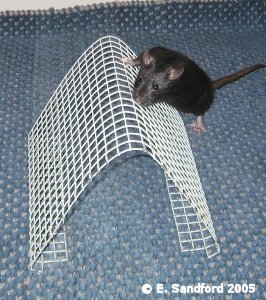
The Derby Bank! This is part of a base mesh from a critter cage bent to make a ramp. It is very important to file down any sharp ends on this obstacle.
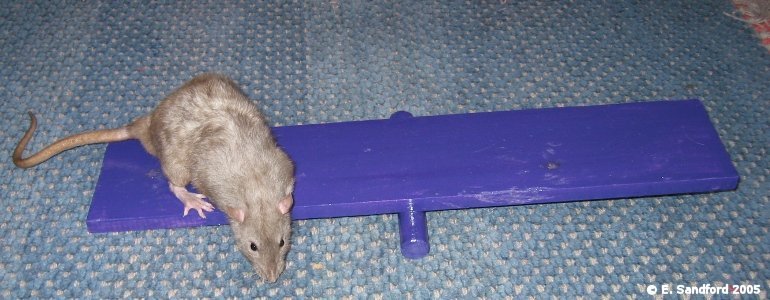
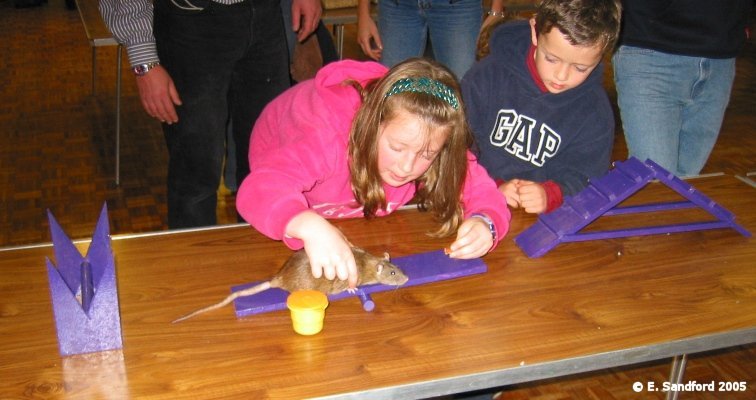
The Seesaw Very simple obstacle to make. Just take a piece of doweling and securely glue it to the middle of a plank - mine is 18 inches long, which seems to balance nicely.
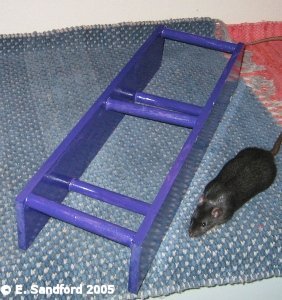
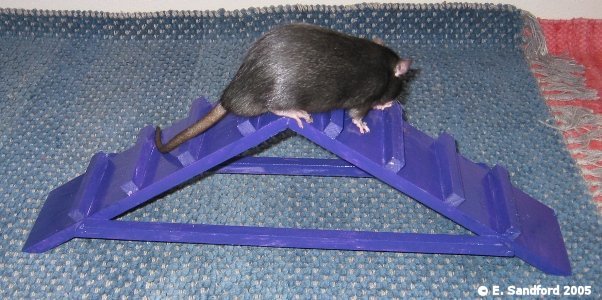
The Ramp This obstacle was my greatest challenge and took the longest to create. I cut two planks and then had to angle the ends to join them and also allow the base ends to sit flat on the table. I added side bars to make the fence more solid and using square doweling for the steps on the ramps. With practice, it would be ideal to have rats touching below both bottom steps as would be expected in dog agility.
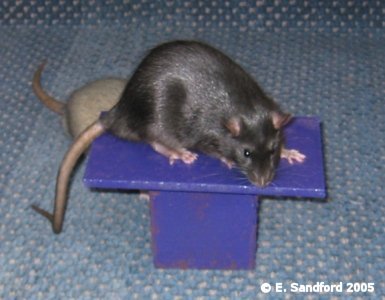
The Table Similarly made to the long jump - nail lump of wood to a square of MDF to make a sturdy little table for use either within the obstacle course to make them stop on it for a few seconds, or just as the table for the staying obedience test.
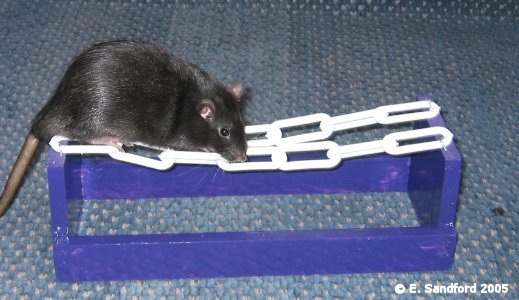
The Chain Walk This obstacle was an experiment really, but it has proved to be a real hit with the rats with most completing it quite easily. The gap between the chains is about an inch and they are quite taunt, so the rat doesn't slip off and fall into the middle. Made fairly simply by using two bits from the planks of wood for the ends and 2inch wide for the side ones. The chain is nailed on with fence staples and is plastic so easy enough to clean down. This obstacle could also be used as a jump by turning it the other way on the course. To Summarise... What you tend to find once you have made a few obstacles is that you look at many things around you in a totally different light - kids toys, household stuff and places like DIY stores, garden centres, IKEA, etc. are seen with a whole new light... Key Guidance For Agility
Obstacle courseScenario
6-8 varying obstacles arranged as a course for rats to follow a route guided by their handler. When thinking obstacles, the kind of things we are looking at are climb over, climb through, balance, weave, water, ramps, tubes, etc. as above. Number of obstacles and shape of course will depend on facilities available. Time allowed for 6-8 obstacles should be 2 minutes maximum and points awarded for speed, number of obstacles completed and style/finesse. Number of obstacles and time allowed may vary from show to show, dependant on what is available and time allowed to run the event. Judging Guidelines
Scoring Guidelines Time: - max of 5 points available
5 points for completing course in
quarter of time allowed – i.e. usually 30 seconds. Obstacles: - 5 points available on obstacles completed roughly divided between number of obstacles on the course. This would be at the judges discretion and should be made clear how the points are accumulated before the event starts but for example if 8 obstacles are used, could be half point per obstacle and a bonus point for completion within allowed time. Interaction, style, finesse, obedience: - maximum of 10 points available based upon the above guidelines. Roughly speaking, these are the kind of level of points expected to be given.
10 points – rat that clearly understands
it’s handler’s signals and follows guidance around the course confidently and
well within the allowed time. i.e. perfection and very unlikely to ever be
awarded!
Other types of EventsCuriosity
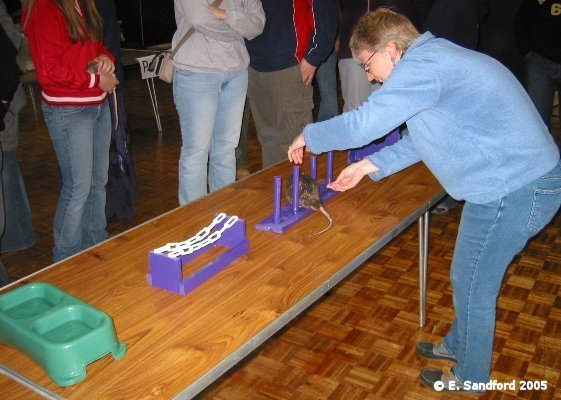
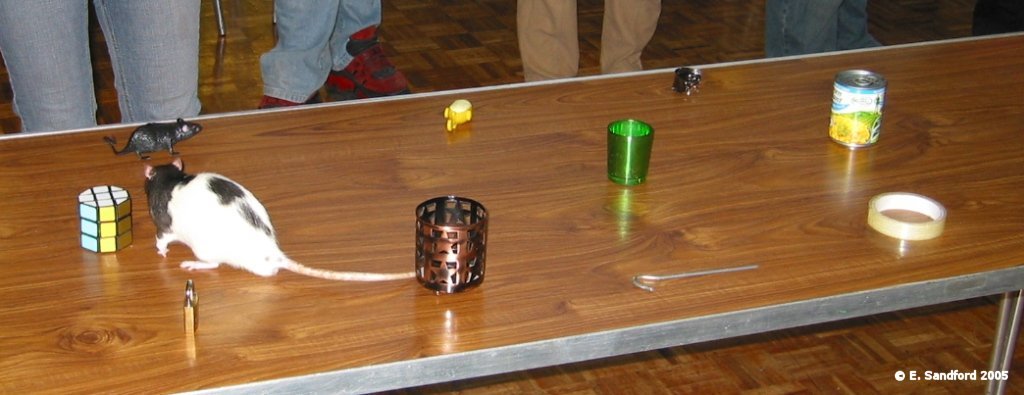
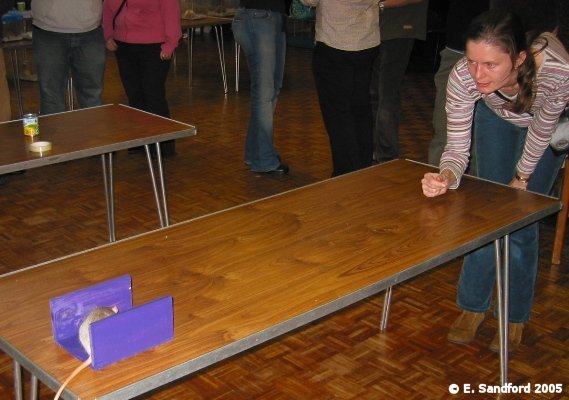
Curiosity is testing the rat’s inbuilt curiosity of their surroundings. It is an event where the handler really has no input and it’s down to the rat. Most rats do quite well in this event. The kinds of items used are random small household items, like keyfob, ornaments, kitchen utensils, plastic rat or similar toys, candle holder, etc. 10 items are randomly placed on a table and the rat is given 1 point per item their nose touches during the allowed 1 minute time. The rat is put on the table at a designated starting point and the handler can encourage verbally and by making signals, but not by any touching of the rat or the table until the designated time is up. If rats touch all the items in under a minute then the winner is the fastest time. ObedienceComing when called The rat is placed at a designated starting point in one corner of the table by its handler and the handler should then move to the corner diagonally opposite and call for the rat. The rat should clearly remain at the starting point until the handler gives a signal to come – this will be the starting point for the stopwatch – rats starting before any command is given should lose 2-3 points based on completion below. A variety of signals (both verbal and noises/handclapping, clicking fingers, tapping table, etc.) can be used but the handler is not allowed to touch the rat after placement on the competition table until the rat has reached the diagonally opposite corner – the handler should not move from the opposite end of the table during the event. Other rats or handlers cannot be used for assistance.
Points should be based on the following guidelines: - 10 points maximum available for this event. Rats starting before any command given should drop 2-3 points based on completion below.
9-10 points for coming immediately on
command. There should be no action beforehand and it should be clear that the
rat has responded to a command by the handler. For maximum points, the rat
should be with their handler in under 10 seconds and follow as close as possible
a straight line across the diagonal of the table. Staying
A smallish platform (like a mini table used for stopping on in dog agility) is placed on the table and the rat is placed on it by its handler. The rat should remain on the platform for as long as possible with competition time set at 1 minute. Verbal and signal encouragement can be given to encourage the rat to stay put but the handler must not touch the rat after placement. No food or treats to be given to the rat during the event. 10 points available and easiest way to break the points up is to divide the minute by 10 so for every 6 seconds the rat remains on the platform they get 1 point. A judge may decide to allocate the points based on 1 point for every 10 seconds the rat remains on the platform and allocate the remainder of the points based on communication and interaction. Additional note – we found it best if everyone apart from the handler stands well back from the table for these two events leaving the rat to concentrate on their handler. |
Images & Text
Copyright © 2009
Estelle Sandford, Alpha Centauri
Please do not reproduce without permission
Last modified:
January 24, 2026